What is an edge in sports betting?
An edge isn't knowing who wins. It's the gap between what something is worth and what you're being charged for it — usually a point or two, and usually absent.
Short answer: an edge is the gap between what you think an outcome is worth and what you're being charged for it. Not a prediction that you're right — a claim that the price is wrong.
It's the single word this whole site rests on, so it's worth doing properly.
The measurement
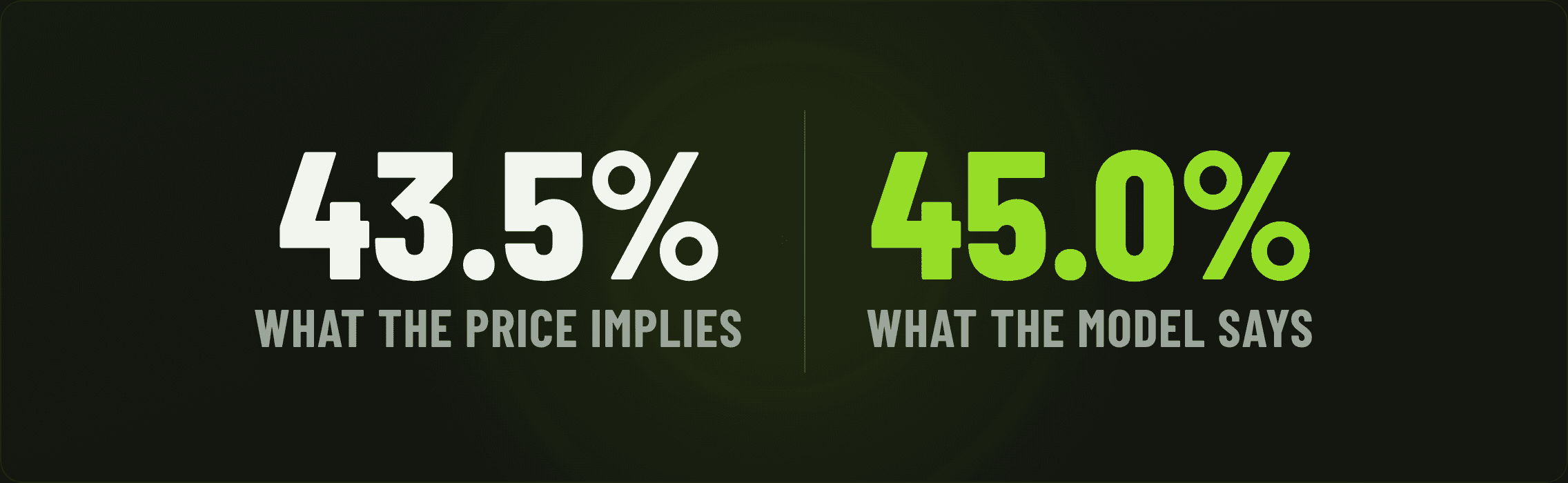
Every price converts to a probability. A price of +130 implies 43.5% — that's the rate at which betting it breaks even.
Now suppose your own estimate of that outcome is 45%.
The gap is 1.5 percentage points, and that gap is the edge. Small. They almost always are.
You can also express it as money. Betting $100 at +130 with a true 45% chance returns, on average:
45% of the time you win $130 → +$58.5055% of the time you lose $100 → −$55.00Expected value: +$3.50 per $100 staked — a 3.5% return.
That's what an edge is worth. Not a win — a small positive expectation, repeated.
What an edge is not
It isn't confidence. A 45% shot loses more often than it wins. You can hold a genuine edge and still lose that bet, and the next one, and the one after. The edge says the price is wrong, not that the outcome is certain.
It isn't a prediction of the result. Our model doesn't try to pick winners. It prices a market and compares its price with the board's. It will happily decline a game it's fairly sure about, because at a short price being fairly sure isn't enough.
It isn't yours because you know something. In a market as heavily traded as the NFL, you are almost never better informed than the price. Edges come from the market being slightly mispriced — a line that hasn't caught up, a side carrying a premium because the public likes it — not from private knowledge.
The part most explanations skip
Here's where edges get inflated, and it's worth understanding before you believe anyone's number.
Take that +130 and the −160 on the other side. Convert both: 43.5% and 61.5%. They sum to 105%, not 100%. Those extra five points are the sportsbook's margin — the price isn't the true probability, it's the true probability plus a surcharge, on both sides at once.
So there are two ways to measure an edge against it.
Strip the margin out first — "de-vigging" — and compare your number against the adjusted price. This makes every edge look larger, because you're measuring against a price nobody will actually give you.
Or measure against the price as offered, margin included, and clear the higher bar.
We do the second. It produces smaller edge numbers and fewer picks than the flattering method would. It's also the only version that describes reality, because the margin isn't theoretical — you pay it on every bet you place. When you see an edge quoted anywhere, the first question worth asking is which of those two things it means.
Why most predictions never become picks
Once you're measuring honestly, most games have no edge at all. The market is right most of the time, and "no edge" is the normal condition rather than a failure.
Every prediction our model makes is checked against a minimum edge threshold configured for that market. Clear it and the pick is published, with its edge printed on it. Fall short and it's held, and never shown to anyone. Most fall short. That's why a day's card is a handful of picks rather than the whole slate, and why a service offering you every game has stopped measuring anything.
How an edge disappears
Three ways, all worth watching for:
The price moves. An edge is a claim about a specific number. If the line has moved a long way from the price we published, the edge that justified the pick is gone — you're now making a different bet with worse maths.
You take a worse price. Betting a published +130 at +115 doesn't reduce your edge, it deletes it. The break-even at +115 is 46.5%, which is above the 45% the edge was built on. Same opinion, same game, no longer a bet.
Late information. The model prices a game before the slate and doesn't read the news wire afterwards. A starter scratched an hour before kickoff can invalidate the number entirely, and nothing downstream re-prices it.
What it looks like over time
An edge of a few percentage points, applied a few times a day, is not exciting to watch. It's a win rate that hovers near half, a record that goes sideways for weeks, and a unit count that grinds upward slowly if the edge was real.
That's also why results here are reported in units with the price attached rather than as a win percentage, and why every pick in the ledger carries the edge it was published at. An edge you can't check afterwards is just a word.
These are model outputs, not guarantees, and not financial advice. A positive expected edge does not mean an individual pick wins, and any betting strategy can lose over any finite sample. If betting has stopped being entertainment for you, our responsible gambling page lists free confidential help.
Published September 4, 2026 · For information only · 21+
Read the theory, then watch it run.
The model's highest-edge play lands in your inbox at 9 AM tomorrow. Free, every day.