Why do betting lines move?
Two forces move a line: new information, and money. Only one of them is about the game — and knowing which is which decides whether your bet still has an edge.
Short answer: two things move a line. New information about the game, and money arriving on one side of it. Only the first is about the teams.
Telling them apart matters more than it sounds, because it decides whether a bet you liked yesterday is still a bet today.
The opener and the close
A line has a life. It goes up early — days before an NFL game, hours before a baseball game — as an opener, usually at lower limits while the book finds out what it got wrong. It then moves, sometimes repeatedly, until the game starts. The final version is the closing line, and it's generally the sharpest number of the week, because it has absorbed everything anyone knew or wagered.
Everything below is about what happens in between.
Reason one: information
The obvious one. Something changes about the game.
A quarterback is ruled out. A starting pitcher is scratched and the replacement is worse. The wind forecast at an open ballpark goes from calm to twenty miles an hour. A team's best defender is added to the injury report on Friday.
These move lines the way you'd expect: the affected side gets worse, the number adjusts, and the new price reflects the new reality. Information moves are the market working correctly.
Reason two: money
The less obvious one, and the reason a line can move on a day when nothing happened.
Sportsbooks make their money from the margin built into the price, not from picking sides. The cleanest version of their business is equal money on both sides: whoever wins, they keep the margin. So when action piles onto one side, they shade the number — or the price — to make the other side more attractive.
This produces movement with no informational content whatsoever. The teams haven't changed. The weather hasn't changed. More people simply bet one way, often for reasons that have nothing to do with value: the popular team, the one on national television, the over rather than the under.
Not all money moves are noise. When a line jumps quickly at several books at once and stays there, that usually reflects large, well-informed money rather than public enthusiasm — and it's closer to an information move wearing a different coat.
A note on what our model does with this: nothing. It doesn't read betting volume, and it isn't trying to follow the market. It prices the game independently and compares its number with the board's. Line movement is something that happens to a published pick, not an input to it.
Why the number sometimes stays and the price moves instead
You'll see a spread sit at −3 while the price around it drifts from −110 to −120 to −130.
That's the key-number effect. Three is the most common margin of victory in football by some distance, so moving from −3 to −3.5 hands away a genuinely valuable half-point. Books resist it and charge more for the same number instead. The line looks stable; the bet is quietly getting worse.
This is why comparing spreads across sportsbooks without comparing their prices tells you very little.
What movement means for a pick you're holding
Here's the practical part, and it's the reason this post exists.
An edge is a claim about a specific number. Our model prices a game, finds the board wrong by enough to clear a minimum threshold, and publishes the pick at that price. That price is part of the pick — not decoration around it.
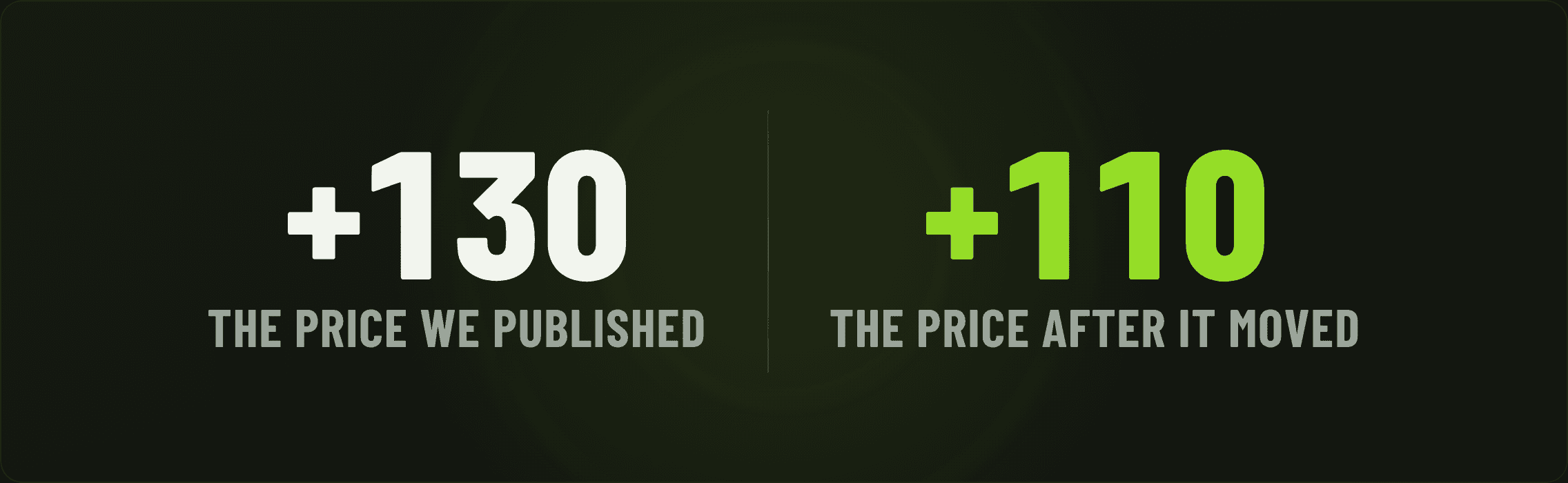
So if the line has moved a long way from what we published, the edge that justified it is gone. You'd be making a different bet: same team, same game, worse maths. A pick published at +130 and taken at +110 needs a 47.6% hit rate instead of 43.5%, and the gap the model found was smaller than that difference.
The honest instruction is the unglamorous one: if the number has moved past the published price, skip it. There will be another card tomorrow. This is also why every pick in our ledger is timestamped and carries the price it went out at — a record without prices attached can't be checked, and a pick whose price has moved isn't the pick that was published.
The one thing worth watching
If you take nothing else from this: the direction a line moves after you bet tells you something.
Consistently getting a better number than the closing line means you're beating the market to the price, which is the mechanism by which betting edges actually exist. Consistently getting a worse one means the market is moving away from you, and a good short-term record is probably luck.
It's not a comfortable measure, because it can tell you you're wrong while you're winning. That tends to be when it's most worth listening to.
These are model outputs, not guarantees, and not financial advice. If betting has stopped being entertainment for you, our responsible gambling page lists free confidential help.
Published September 8, 2026 · For information only · 21+
Read the theory, then watch it run.
The model's highest-edge play lands in your inbox at 9 AM tomorrow. Free, every day.