Are parlays worth it?
Usually not, and the reason is arithmetic rather than opinion. A parlay doesn't add the sportsbook's margin, it multiplies it.
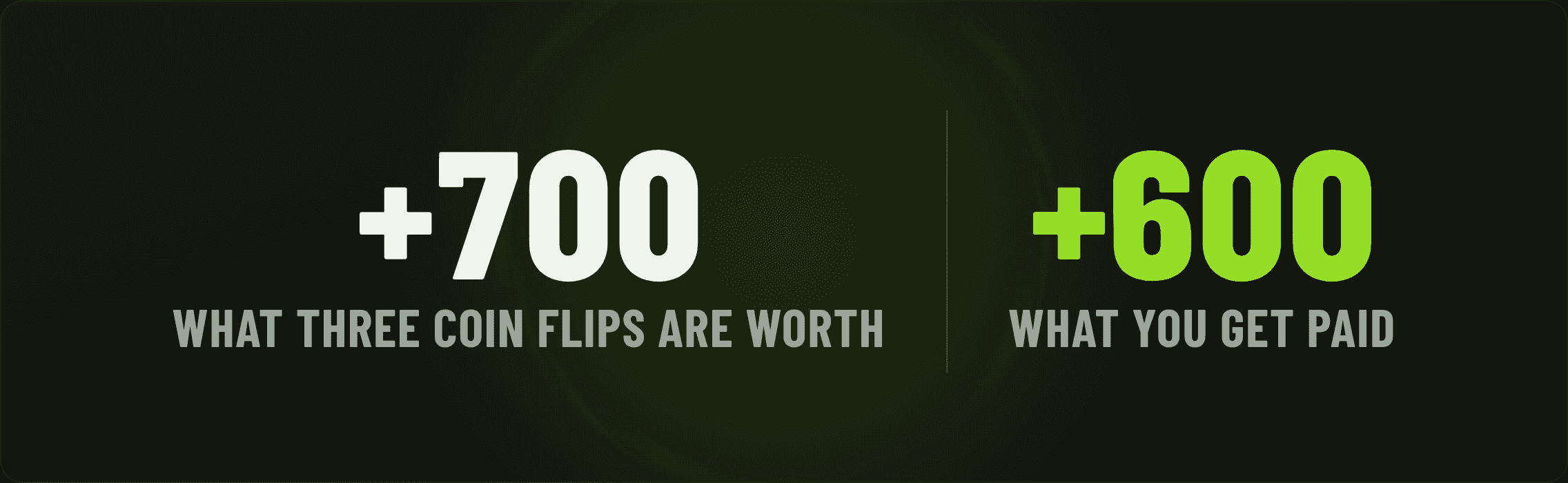
Short answer: usually not. And the reason is not taste, it is arithmetic. A parlay does not add the sportsbook's margin, it multiplies it.
That said, there is a narrow case where a parlay is defensible, and it is worth knowing what it is.
What a parlay is
A single bet made of several legs, all of which must win. Three sides, four totals, some mixture. Miss one and the whole thing loses.
The appeal is obvious: small stake, large return, and the entertainment of having something to watch all afternoon. The problem is that the price you are paid for accepting that risk is not a fair one, and the shortfall compounds.
The arithmetic
Take three legs, each priced at −110, the standard price on a spread or a total.
Suppose each leg is genuinely a coin flip. The chance of hitting all three is 0.5 × 0.5 × 0.5 = 12.5%, which means a fair payout would be +700: risk $100, win $700.
A typical three-team parlay pays +600.
Run that through:
12.5% of the time you win $600 → +$75.0087.5% of the time you lose $100 → −$87.50Expected value: −$12.50 per $100 staked.
Now compare it with betting those same three games individually at −110. At a 50% hit rate you would lose about $4.55 per $100 staked.
The parlay costs you roughly 2.7 times as much. Same three opinions, same three games, nearly three times the leak. The house edge on a single bet is small and grinding. On a parlay it is the largest edge in the building outside the slot floor, which is precisely why parlays are marketed so hard.
Every leg you add makes it worse, not better.
Why the shortfall compounds
Each leg carries the book's margin, that surcharge baked into every price. Bet three games separately and you pay that margin three times, in sequence, on separate bets.
Bet them as a parlay and the margins multiply rather than add. The parlay payout is calculated from prices that each already include a cut, so what you are offered sits further below fair value with every leg. The gap between +700 and +600 in the example above is that compounding, expressed as money.
The narrow case where it's defensible
Here is the honest caveat that most "parlays are a sucker bet" posts leave out.
The maths above assumes each leg is a coin flip, with no edge. If each leg genuinely carries a positive expectation, that compounds too. Three legs each with a real edge produce a parlay whose edge is larger than any single leg's, for the same reason the margin compounds against you when they do not.
The catch is the word genuinely. An edge is a small thing, a point or two of probability, and it has to survive being multiplied against a payout that is already shaded. Three legs at a true edge might clear the compounded margin. Three legs you merely like will not, and the difference between those two states is not something most bettors can tell from the inside.
There is a second catch: correlation. Legs from the same game usually are not independent. A team's total and its own over tend to move together, and sportsbooks either block those combinations or price them separately as same-game parlays, at worse odds. The parlays that would actually be worth making are the ones you are not allowed to make cheaply.
Why we don't publish parlays
Our model prices individual markets. It produces a probability for one specific market in one specific game, compares it against that market's price, and publishes when the gap clears a minimum threshold. It does not price combinations, and it does not model the correlation between two legs, so a parlay assembled from our picks would carry a claim we have not actually made.
If you want to combine published picks yourself, the arithmetic is yours to do and the correlation risk is yours to carry. What we will not do is put a number on it that we have not earned.
That is also why the record is reported in units on single bets, with the price attached to each one. A parlay record is much harder to hold anyone to, because a service can bury a lot of losing legs behind one screenshot of a hit.
The short version
A parlay is not a strategy. It is a way of paying the house edge several times in one transaction, in exchange for a payout that looks larger than it is.
If you enjoy them, size them like entertainment rather than investment: a small fraction of what you would stake on a single bet, from money you have already decided you can lose. That is a different activity from betting an edge, and there is nothing wrong with it as long as you know which one you are doing.
These are model outputs, not guarantees, and not financial advice. If betting has stopped being entertainment for you, our responsible gambling page lists free confidential help.
Published September 14, 2026 · For information only · 21+
Read the theory, then watch it run.
The model's highest-edge play lands in your inbox at 9 AM tomorrow. Free, every day.