What is a point spread?
The number next to the favourite isn't a prediction of the score. It's a handicap chosen to make both sides equally tempting — which is exactly what makes it beatable.
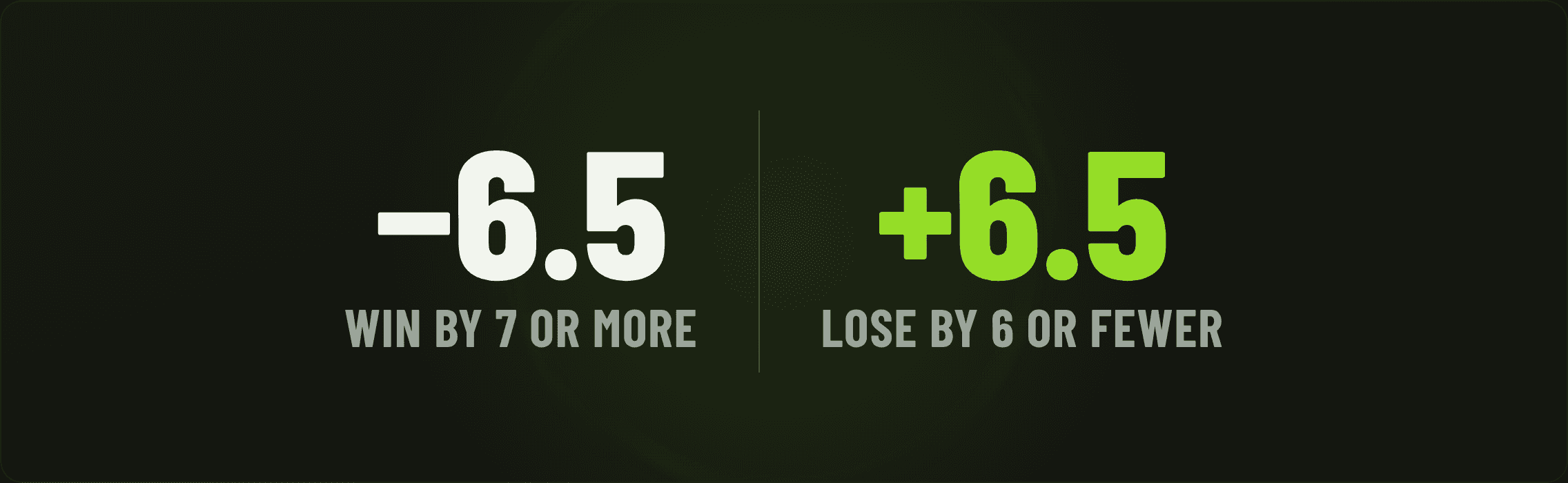
Short answer: a point spread is a handicap. The favourite has points subtracted from its score; the underdog has points added. You bet on which side wins after that adjustment, not on who wins the game.
It's the most common way to bet American football and basketball, and it's the market where most NFL money sits.
Reading the number
Suppose a game is posted like this:
- Chiefs −6.5
- Broncos +6.5
The minus sign marks the favourite. Chiefs −6.5 means they need to win by seven or more for that bet to win. Broncos +6.5 means they need to lose by six or fewer, or win outright.
Either side can cash. A Broncos bettor doesn't need the Broncos to win — only to stay within the number. That's the whole idea: the handicap turns a lopsided game into something close to a coin flip.
The verb you'll see is cover. A favourite that wins by more than the spread has covered. One that wins by less has won the game and lost the bet, which is a specific kind of Sunday afternoon.
Why the half-point
The .5 exists to make ties impossible.
At a whole number the game can land exactly on it. Chiefs −7, Chiefs win by exactly seven: nobody covered. That's a push, and everyone gets their stake back. Not a loss, but not a win either, and a graded record has to account for pushes separately — which is why you'll see them in our ledger as their own outcome rather than folded into wins or losses.
A half-point removes that possibility. Sportsbooks call it the hook, and it's the difference between a refund and a loss more often than casual bettors expect.
The number and the price are two different things
This trips people up constantly, so it's worth separating cleanly.
The spread is the handicap: −6.5.
The price is what you pay to take it, usually −110, meaning you risk $110 to win $100 and need to hit 52.4% just to break even.
Both move, and they move independently. A book can leave the spread at −6.5 and shift the price from −110 to −120 to attract money to the other side. Two sportsbooks can offer the same −6.5 at different prices. If you're only comparing spreads and ignoring the price attached, you're reading half the market.
Key numbers, and why 3 is different from 4
Football scores don't distribute smoothly. They cluster on the values you can actually make: three points for a field goal, seven for a touchdown and extra point.
The single most common NFL margin of victory is three. Seven is next. That means a spread of 3 sits on top of a genuine pile of outcomes, and moving from −3 to −3.5 is a much bigger deal than moving from −4 to −4.5, even though both are half a point on paper. Games land on exactly three all the time; they land on exactly four far less.
This is why you'll see books resist moving off 3 and adjust the price instead. It's also why a half-point either side of a key number is worth more than a half-point anywhere else.
What the spread is actually claiming
Here's the part that matters most, and the part most explanations skip.
A point spread is not the sportsbook's prediction of the final margin. It's the number the book believes will draw roughly equal money to both sides — a price, set by what bettors will do, not a forecast of what the teams will do.
Those two things are usually close, because a number far from the truth attracts one-sided money and gets moved. But they aren't the same thing, and the gap between them is the only place a bet with positive expectation can live.
That's what our model is looking for. It doesn't try to guess the final score. It produces a probability for a specific spread market, converts that probability into its own fair price, and compares it against the price on the board. Where the two agree, there's nothing to bet — the market is right most of the time. A pick only exists where the gap is large enough to clear a minimum edge threshold, and most predictions never become picks.
Reading a spread record
One consequence worth carrying into any track record you look at, ours included.
Spread bets at −110 pay less than they risk, so a 52% record is roughly break-even and a 55% record is a serious edge. The gap between "profitable" and "unprofitable" is a few percentage points wide, and no single week tells you which side of it a bettor is on.
That's why results here are reported in units with the price attached to every pick, rather than as a win percentage. A spread record without prices attached isn't a record. It's a number without the context that makes it mean anything.
These are model outputs, not guarantees, and not financial advice. If betting has stopped being entertainment for you, our responsible gambling page lists free confidential help.
Published August 25, 2026 · For information only · 21+
Read the theory, then watch it run.
The model's highest-edge play lands in your inbox at 9 AM tomorrow. Free, every day.