What does -110 mean in betting?
The most common price in sports betting, what it costs you, and the win rate you have to clear before you make a cent.
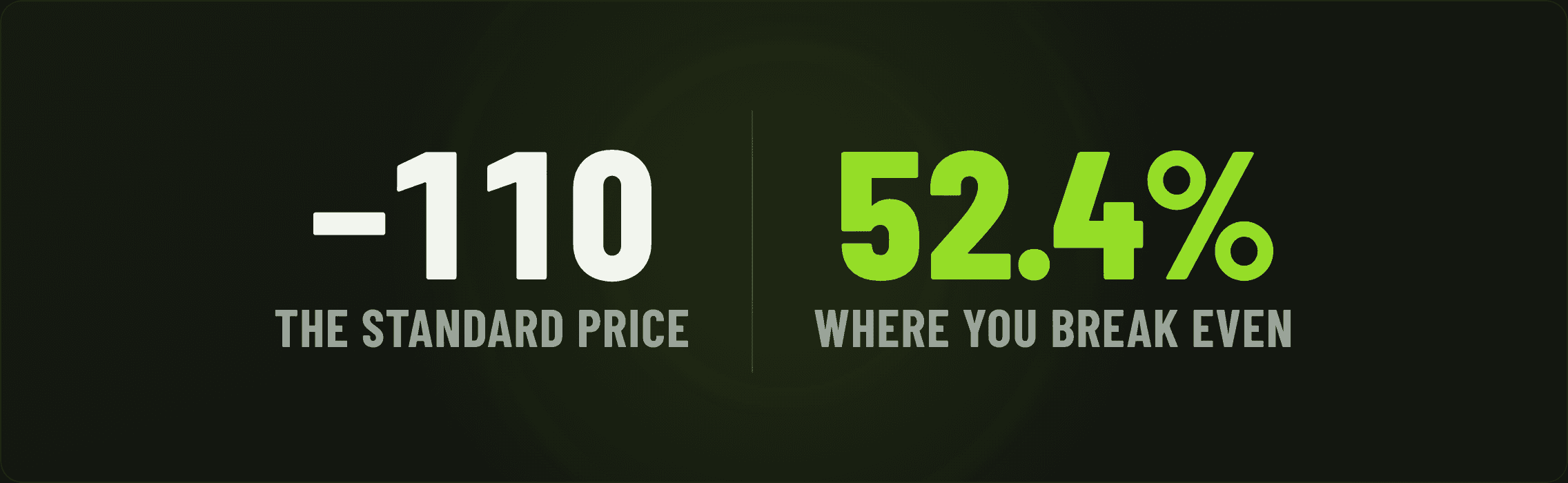
Short answer: a price of -110 means you risk $110 to win $100. Bet $110, and a winner returns $210 — your $110 back plus $100 in profit. A loser costs you the $110.
You will see -110 more than any other number in sports betting. It is the default price on point spreads and totals at most sportsbooks, and it is the number every discussion of "beating the market" is quietly built on.
It is worth understanding properly, because it is also where the sportsbook makes its money.
Why -110 and not -100
A point spread is designed to be a coin flip. The book sets the line so that roughly half the money lands on each side.
If the price were -100 — risk $100 to win $100 — a book taking equal money on both sides would make nothing. It would pay the winners exactly what it collected from the losers.
So it shades the price. At -110, both sides risk $110 to win $100. Take equal action on each side and the book collects $220, pays out $210, and keeps $10 regardless of who wins.
That $10 is the margin. It goes by several names — the vig, the juice, the overround, the hold — and it is the single most important thing standing between a bettor and a profit.
The number that actually matters: 52.4%
Because you risk more than you win, breaking even takes more than half your bets.
The math is short. If you win a fraction w of your bets at -110, you collect 100w and pay out 110 × (1 − w). Set those equal and w works out to 110 ÷ 210 — 52.38%.
Round it and you get the number that gets quoted constantly: 52.4%.
Win 52.4% of your bets at -110 and you finish exactly where you started, having done a great deal of work for nothing. Win 50% — genuinely coin-flipping, which is what most bettors actually do — and you lose money steadily. Not because you were unlucky, but because the price guaranteed it.
Breakeven at other prices
Every price has its own breakeven rate. A few worth knowing:
- -105 — risk $105 to win $100. Breakeven 51.2%.
- -110 — the standard. Breakeven 52.4%.
- -120 — risk $120 to win $100. Breakeven 54.5%.
- +100 (even money) — risk $100 to win $100. Breakeven 50%.
- +110 — risk $100 to win $110. Breakeven 47.6%.
- +150 — risk $100 to win $150. Breakeven 40%.
Notice how much moves between -105 and -120. That is a three-point swing in the win rate you need, from the same bet at a slightly different price. Shopping for a better number is not a rounding error — for a bettor operating on thin margins it can be the entire margin.
If you prefer decimal odds, -110 converts to 1.91. The conversion for any negative price is 1 + (100 ÷ the number), ignoring the minus sign.
Where the margin hides
Here is the part most explanations skip.
Turn -110 into an implied probability and you get 52.4%. Do it for both sides of the same market and you get 52.4% and 52.4% — which add up to 104.8%, not 100%.
Those extra 4.8 percentage points are the margin, expressed as probability. The market is not telling you the true chance of each outcome; it is telling you the true chance plus a surcharge.
This matters when anyone claims to have found an edge. There are two ways to measure one. You can strip the margin out first — "de-vigging" — which makes every edge look larger, because you are comparing your number against a price nobody actually offers. Or you can measure against the price as it stands, margin included, and clear a higher bar.
We do the second one. Our edge is measured against the price you can actually bet, with the book's cut still in it. It produces smaller numbers and fewer picks. It is also the only version that means anything, because the margin is not theoretical — you pay it on every bet you place.
What to take from this
A few things follow from one number:
Being right more than half the time is not enough. The bar is 52.4% at standard pricing, and most professional bettors live somewhere between 53% and 57%. That gap — a few percentage points — is the entire business.
Price is not a detail. The same opinion at -105 instead of -120 changes what you need to be right about by more than three points.
Win rate on its own is close to meaningless. A 60% record made entirely of -200 favourites loses money. A 48% record made of +150 underdogs prints. This is exactly why our published record is reported in units rather than as a win percentage, and why every pick in the ledger carries the price it was published at.
The house edge in sports betting is smaller than in almost any casino game. It is also relentless, and it is applied to every single wager. Knowing precisely what it costs is the first thing that separates betting from gambling.
Published August 24, 2026 · For information only · 21+
Read the theory, then watch it run.
The model's highest-edge play lands in your inbox at 9 AM tomorrow. Free, every day.