What is a moneyline bet?
The simplest bet in sports: pick the winner. Which is exactly why it's the one where the price does all the work and most people never look at it.
Short answer: a moneyline bet is a bet on who wins the game. No handicap, no points added or subtracted — just the result.
The complexity isn't in the bet. It's in the price, and the price is doing all the work.
Reading the two numbers
A game might be posted like this:
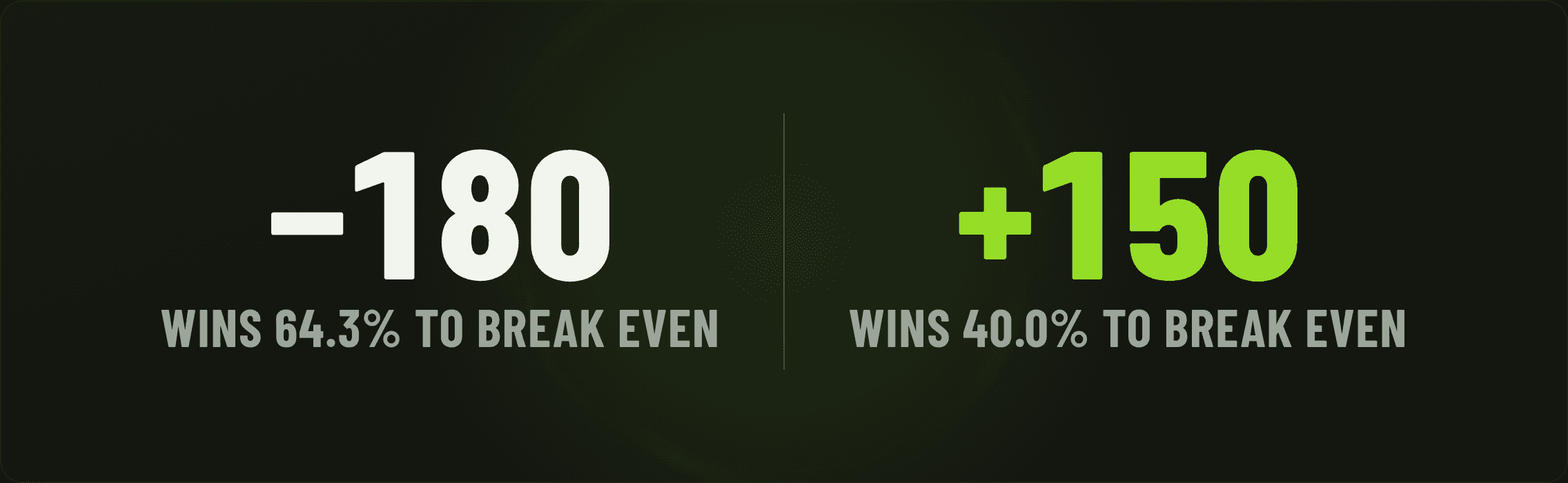
- Home −180
- Away +150
The favourite carries the minus. −180 means you risk $180 to win $100. Bet $180, win the game, collect $280 — your stake plus $100 profit.
The underdog carries the plus. +150 means you risk $100 to win $150. Bet $100, win, collect $250.
Note what's changed from a point spread. There the number was the handicap and the price sat quietly at −110 in the background. Here there's no handicap at all, so the price has to carry the entire difference between the two teams. That's why moneyline odds swing so far — a −900 favourite and a +700 underdog are describing a mismatch a spread would express as a number of points.
What a price is claiming
Every price converts to an implied probability. That's the whole trick, and it takes one line of arithmetic.
- −180 implies 64.3% — 180 ÷ 280.
- +150 implies 40.0% — 100 ÷ 250.
Add them: 104.3%. Not 100%.
Those extra 4.3 percentage points are the sportsbook's margin, the same thing that makes −110 cost you more than it looks. The market isn't telling you each side's true chance. It's telling you the true chance plus a surcharge, on both sides at once.
Every moneyline you've ever seen has been quoted this way. Once you can convert a price to a probability in your head, you stop reading odds as "who's better" and start reading them as "what's being claimed, and what does it cost me to disagree."
The favourite trap
Here's where most money goes.
Backing −180 favourites feels safe, and it delivers the sensation of winning. You'll win roughly two-thirds of those bets. Two-thirds sounds excellent.
It's break-even. 64.3% is precisely the rate at which −180 stops making and starts losing money. Win 60% of your −180 bets — a strong-looking record by any casual standard — and you're losing steadily.
The underdog is the mirror image. +150 needs only 40%. Losing three out of five bets and still making money is not a paradox; it's the ordinary arithmetic of being paid more than even money.
This is why a win percentage on its own tells you almost nothing about a moneyline bettor, and why our record is reported in units with the price attached to every pick. You can see it directly on the MLB record: a win rate that looks unremarkable sitting next to a positive unit return isn't a contradiction, it's what a record built partly on underdogs looks like.
Where the moneyline matters most
In baseball, it's the main event. Run margins are small and erratic — a third of games are decided by one run — so most baseball money sits on the winner rather than the margin. That's also why a −180 favourite in baseball is a genuinely big favourite, where the same price in basketball would be unremarkable.
In football and basketball, it's the specialist option. Most action goes to the spread, and the moneyline gets used at the extremes: backing a big underdog outright, or paying up on a favourite when you think the spread is the harder bet.
Worth knowing about public money: it leans heavily toward favourites and toward the over, because backing the better team and rooting for points is more enjoyable than the alternative. Sportsbooks are aware of this, and prices on popular sides can carry a premium for it. That premium is not a conspiracy — it's just the price responding to demand, exactly like everything else.
What our model does with it
The same thing it does with every market, which is deliberately unglamorous.
It produces a probability for the moneyline in a specific game, converts that probability into its own fair price, and compares it against the price on the board — with the book's margin left in, which is the harder comparison rather than the flattering one. Where the two agree there's no bet, and they agree most of the time. A pick exists only where the gap clears a minimum edge threshold, and most predictions never become picks.
Note what that isn't. It isn't picking winners. A model can be quite sure a favourite will win and still refuse the bet, because at −180 being sure isn't enough — you need to be more sure than 64.3%, and by enough of a margin to be worth the risk. Most of the time, the market got there first.
These are model outputs, not guarantees, and not financial advice. If betting has stopped being entertainment for you, our responsible gambling page lists free confidential help.
Published August 28, 2026 · For information only · 21+
Read the theory, then watch it run.
The model's highest-edge play lands in your inbox at 9 AM tomorrow. Free, every day.