What is a run line?
Baseball's spread, frozen at 1.5 runs. Because the number never moves, the price has to — which is why a favourite can pay plus money and an underdog can cost you.
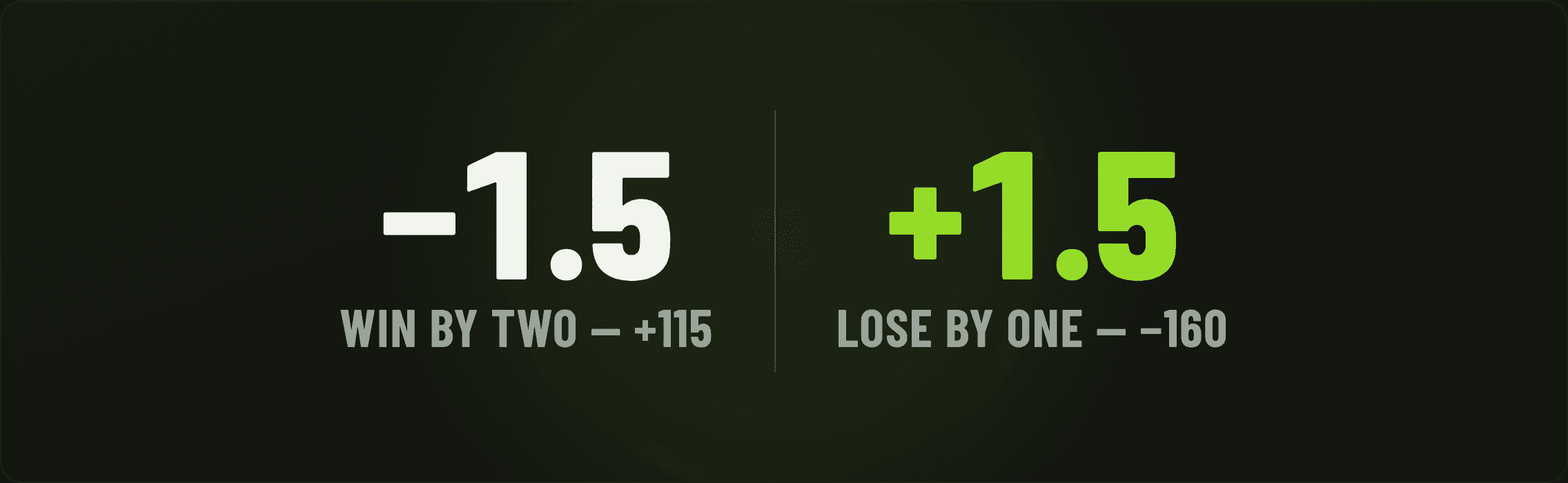
Short answer: the run line is baseball's version of a point spread, and it is almost always set at 1.5 runs. The favourite has to win by two or more. The underdog can lose by one and still cash.
What makes it interesting is what's different from football. A point spread moves — 6.5, 7, 7.5 — and the price sits quietly at around −110. The run line does the opposite. The number is frozen at 1.5, so the price does all the moving, and it moves a long way.
Reading it
A game might be posted like this:
- Home −1.5 (+115)
- Away +1.5 (−160)
The home team must win by two or more, and pays +115 — you risk $100 to win $115. The away team can lose by exactly one run and still win the bet, but it costs you: −160 means risking $160 to win $100.
Look at what happened there. The home side is the favourite to win the game outright, and yet on the run line they pay plus money. That's not a mistake. Winning by two is a materially harder thing than winning, and the price says so.
Why 1.5, and why it never moves
Baseball scores are low and games finish close. Close to a third of MLB games are decided by a single run — the margin the run line is built on.
That's precisely why the number can stay fixed. In football, a matchup between an excellent team and a poor one might need a handicap of fourteen points to be a fair coin flip; a single number couldn't serve every game. In baseball the gap between the best and worst teams, expressed in runs, is small enough that 1.5 works as a universal line. The variation gets pushed into the price instead.
One consequence worth having: a run line can't push. At 1.5 there's no whole number to land on, so every bet resolves win or loss. No stake returned, no push in the ledger. It's the cleanest of the four markets in that respect.
The trade you're actually making
This is the part worth internalising, because it cuts both ways.
Taking −1.5 on a favourite converts a bet you'd otherwise make at short odds into one that pays properly. A team priced at −180 to win — where you'd need to be right 64.3% of the time — might be +115 to win by two, which needs only 46.5%. You've been paid more, and in exchange you've taken on the risk of the one-run win, which is the single most common way a baseball game ends.
Taking +1.5 on an underdog is the mirror, and it's where more money quietly goes. It feels close to free: your team can lose and you still collect. But at −160 you need to be right 61.5% of the time. A bet that feels like insurance is asking you to clear a bar most bettors never clear on anything. The safety is real; it just isn't cheap, and the price is not shy about saying so.
Neither of those is better than the other. They're different bets on the same opinion, and which one is right depends entirely on whether the price has the one-run margin correctly valued.
What moves a run line
The same forces that move the moneyline, weighted differently.
Starting pitchers matter most, as they do everywhere in baseball, but for the run line what matters is how a pitcher wins — a starter who works deep into games behind a strong bullpen produces more two-run margins than one who hands over a one-run lead in the sixth. Bullpen quality carries unusual weight here, because most one-run leads are decided by relievers.
Then the park and the weather, which is really a question of whether the game is likely to be high- or low-scoring. Blowouts are easier to come by in a hitters' park on a warm night with the wind blowing out. A low-scoring game compresses margins toward one run, which is the underdog's friend.
How the model handles it
The run line is priced by its own model, not derived from the moneyline. That distinction is the point: the model that prices whether a team wins is not the model that prices whether it wins by two, and the two can disagree about the same game.
For each one, the model produces a probability, converts it to its own fair price, and compares that against the price on the board — with the sportsbook's margin left in. Where the two agree there's no pick. A pick exists only where the gap clears a minimum edge threshold, and most predictions never become picks.
You can see how run-line picks have actually done, alongside moneylines and totals, in the by-market breakdown on the MLB record. It's reported in units rather than win rate for exactly the reason this post has been circling: at prices that swing from +115 to −160, a win percentage on its own tells you almost nothing.
These are model outputs, not guarantees, and not financial advice. If betting has stopped being entertainment for you, our responsible gambling page lists free confidential help.
Published August 31, 2026 · For information only · 21+
Read the theory, then watch it run.
The model's highest-edge play lands in your inbox at 9 AM tomorrow. Free, every day.